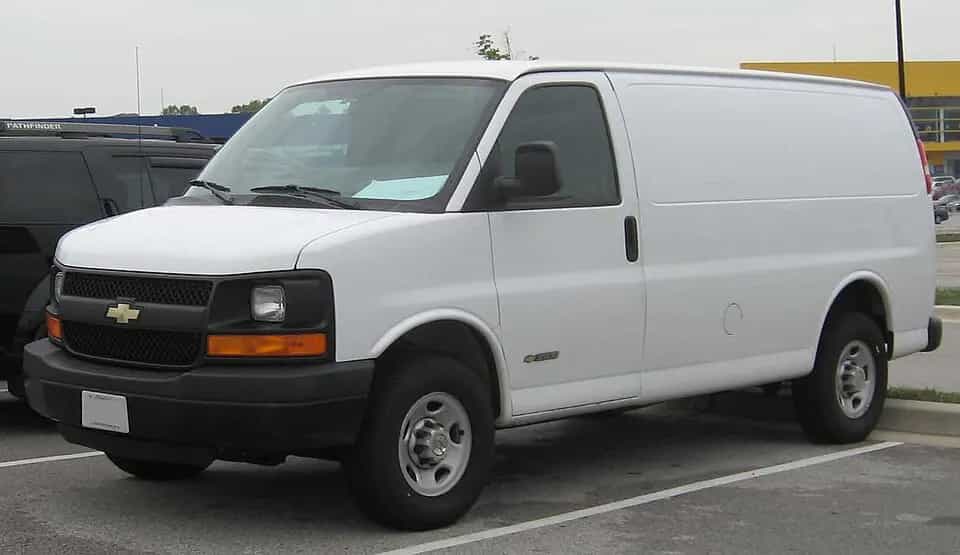
Chevrolet Express Cargo
Importing a used Chevrolet Express Cargo from the USA
The Chevrolet Express Cargo is old-school American workhorse engineering — body-on-frame, rear-wheel drive, and built to be simple, tough and easy to fix. It was never a mainstream European van, which is exactly why importers seek it out: for camper conversions, mobile businesses, big-load hauling or simply the look of a full-size US van on German plates. USCar Trader operates as an independent broker for used US vehicles, so we source a specific Express to your brief. It is a commercial vehicle, and its customs and approval path differ in detail from a passenger car, which we cover below.

Production years and key changes
The Express (and its GMC Savana twin) rides on the GMT610 platform introduced in 1996 and produced with remarkable longevity, receiving updates rather than full redesigns. The Express 1500 half-ton was discontinued after 2014, leaving the heavier-duty 2500 and 3500 ratings as the mainstays. Two wheelbases are offered — the standard and the extended (long) body — giving very different cargo volumes. Because the platform ran for decades, a used Express can be anything from an early-2000s van to a nearly new example, so pinning down the year and rating is the first job.
What is under the hood
The modern Express is defined by its petrol V-engines. The 4.3-litre LV1 V6 (around 276 hp from 2018) became the workhorse base engine, while the 6.0-litre L96 Vortec V8 (around 341 hp) served heavier duty. From 2020, a 6.6-litre L8T V8 arrived on 2500/3500 vans. Chevrolet also offered a 2.8-litre Duramax LWN turbo-diesel four-cylinder for a few years (roughly 2017–2019) for buyers chasing economy. Transmissions are the 6L90 six-speed automatic, with an 8L90 eight-speed on the newest 6.6L vans. Drive is rear-wheel only — all-wheel drive was dropped after 2014.
Trims and body styles
The Express Cargo is a commercial van, so "trim" mostly means configuration rather than luxury: standard or extended wheelbase, 2500 or 3500 GVWR rating, and choices around glazing, partitions, seating (two or three up front) and door types (hinged or optional swing-out rears). Cargo variants strip out rear seating for maximum load volume, while the Passenger version — covered separately — adds windows and seats. Options run to upfit-friendly features rather than comfort extras, though later vans gained modern infotainment and safety aids.
What the US market offers
Supply is deep. The Express is a fleet staple across the US, so used examples are plentiful across a very wide mileage range — from high-mileage ex-fleet vans to lower-use recent examples. Condition varies more than with a passenger car, since many led hard working lives; a careful history and inspection matter more here than anywhere. Extended-body 2500 and 3500 vans are the common conversion base. We do not quote Euro prices; the value is that you can be specific about wheelbase, rating and engine.
Who this import is for
Import a used Express Cargo if you want a big, simple, rear-drive American van for a camper build, a business, or heavy hauling, and you value mechanical simplicity over modern van refinement. It suits buyers who will use its space and payload, or who want the distinctive full-size US van character. If you need front-wheel-drive compactness, low running costs or car-like driving manners, a European panel van fits better.
Technical data and figures
| Attribute | Detail (year/rating-dependent) |
|---|---|
| Body style | Full-size cargo van, body-on-frame |
| Platform | GMT610 (1996–present) |
| Ratings | 2500 and 3500 (1500 to 2014) |
| Wheelbases | Standard and extended (long) |
| Base petrol engine | 4.3L LV1 V6, ~276 hp (from 2018) |
| V8 petrol | 6.0L L96 V8, ~341 hp; 6.6L L8T (2020+) |
| Diesel (2017–2019) | 2.8L Duramax LWN turbo-diesel I4 |
| Transmission | 6L90 6-speed; 8L90 8-speed (6.6L) |
| Drivetrain | Rear-wheel drive (AWD dropped after 2014) |
| Fuel | Petrol (regular) or diesel |
| Seating (cargo) | 2–3 front |
| Assembly plant | Wentzville, Missouri, USA |
| Origin marking | Neutral — duty depends on actual build plant |
Reliability: trouble spots to check
The Express earns its reputation for durability through simplicity: proven GM V-engines, a stout six-speed automatic and a body-on-frame structure with no complex drivetrain electronics. That does not make it maintenance-free. The 4.3L V6 is dependable but works hard in a heavy van; the 6.0L V8 is strong but thirsty. Common items on higher-mileage vans include fuel pump and fuel-level sender faults, intake gasket and cooling-system wear on older engines, brake wear from heavy loads, and front suspension components after years of hard fleet use. Rust is the biggest single concern — vans from northern, road-salt states can corrode along the body, floor and frame, so a thorough underbody inspection is essential. The Duramax diesel adds emissions hardware (DPF, EGR) that must be intact and functioning. A working van that has been serviced and kept out of the salt is a genuinely long-lived vehicle.
US vs. Europe differences
As a US commercial vehicle, the Express carries US lighting, no rear fog lamp, miles-based instruments, and US safety and emissions configuration. Full-size US vans are wider and longer than typical European panel vans, which has practical implications for parking and, for camper use, for registration class and weight ratings. The petrol V8s consume considerably more fuel than a European diesel van, a point worth weighing before import. None of this blocks approval, but the commercial classification means the paperwork and weight/dimension checks deserve attention.
How the import works
The sequence is: select the exact van and VIN; run a VIN and build-plant origin check to establish the customs treatment; pay via secure escrow so funds release only on agreed terms; book ocean freight (usually RoRo for a van of this size, or container) to a port such as Bremerhaven; clear customs on arrival; complete a TÜV inspection with individual approval (Einzelabnahme under §21 StVZO), including commercial-vehicle weight and dimension checks; and register in Germany. We coordinate each stage through to your registration office.
Import duty, VAT and fees
Remember: no origin proof, no 0% duty – and 19% German import VAT is due on every import.
The Express is marked neutral, so the import duty depends on where the specific van was actually built, proven via the VIN and plant code. In practice the Express is assembled in Wentzville, Missouri, so many vans have provable US origin; where that origin is established and the conditions of Regulations (EU) 2026/1455 and 2026/1461 are met (in force since 1 July 2026, direct transport, valid until 31 December 2029), a 0% EU import duty can apply. This is never automatic or guaranteed and must be documented. Separately and in all cases, the 19% German import VAT (Einfuhrumsatzsteuer) is due. Commercial-vehicle duty categories can differ from passenger cars, so we confirm the correct classification per VIN. We add no margin; freight, any duty and VAT are shown separately.
From modifications to registration
Typical approval work includes fitting a rear fog lamp, adjusting or replacing headlights to European specification, verifying the speedometer and adding km/h where needed, documenting the odometer, and confirming that side-marker and lighting arrangements meet German rules. For camper conversions, additional inspection of the build, weights and seating applies. Once individual approval is issued, registration proceeds in the appropriate vehicle class.
Pre-buy inspection points
- Confirm the VIN, Wentzville build and GVWR rating for the correct customs and registration class.
- Order a Carfax or AutoCheck history and review commercial/fleet use and title status.
- Insist on a clean title; treat salvage/rebuilt with care on a working vehicle.
- Inspect the frame, floor and body thoroughly for rust, especially on salt-state vans.
- Check engine service history, cooling system and, on diesels, that DPF/EGR are intact.
- Test brakes, suspension and steering under load-relevant conditions.
- Confirm mileage against records and check for fuel-pump/sender faults.
What buyers ask most
Can I import a used Chevrolet Express Cargo to Germany?
Yes. It can be imported as a used commercial vehicle and approved for German registration via individual approval.
Does the Express qualify for 0% EU import duty?
It is built in Wentzville, Missouri, so it often has provable US origin. With valid VIN evidence and all conditions met, 0% duty can apply — but it is never guaranteed, and commercial classification is confirmed per van.
Is the 19% import VAT always due?
Yes. The 19% German import VAT applies to every import regardless of the duty rate.
Which Express engine should I choose?
The 4.3L V6 is the efficient workhorse; the 6.0L or 6.6L V8 suits heavy loads; the 2.8L Duramax diesel offers the best economy where available.
Is the Express reliable?
Mechanically yes, thanks to its simplicity. Rust and hard fleet use are the main risks, so inspection and history matter.
Does it have all-wheel drive?
No. AWD was dropped after 2014; modern Express vans are rear-wheel drive only.
Can it be converted into a camper and registered?
Yes. Conversions are common; the build, weights and seating are checked during individual approval and the van is registered in the appropriate class.
Can you find a specific wheelbase and rating?
Yes. As a broker we search the US market for the exact wheelbase, 2500/3500 rating and engine you need.
See more Chevrolet in the Carhub, compare the related Chevrolet Express Passenger and Chevrolet Silverado 1500, or view current Express Cargo listings.